


Surviving Web3: The most common Web3 startup challenges and how founders overcome them
Reading time:
Category:
Operating and growing a business in Web3 can be tough. The market and the audience you’re addressing are both somewhat unforgiving, as well as volatile. Any founder in this space needs to be aware of the overall sentiment within both the Web3 market and the overall economy as well, to be able to see and understand trends and adapt to everchanging market conditions. Many businesses have failed, but founders who prepare and plan carefully and execute their business strategy well, have the ability to navigate the difficult waters of Web3.

Just like in any other tech-related industry, building and growing a business in web3 comes with a variety of challenges. Whether it is finding the right product market fit, building a reliable and skilled team, or even securing funding to ensure an ample runway for your company, being successful in Web3 comes with a variety of web3 startup risks.
Building in web3, however, comes with a set of unique challenges that are different from those in most other industries. Let’s have a look at those challenges and see how to overcome them and avoid common pitfalls and mistakes founders make in Web3.
What are the biggest challenges for Web3 startups?
Challenges come in all shapes and sizes for Web3 founders, some of which are commonly known and obvious, others that are unique to Web3. The biggest challenges for startups in Web3 are:
- Getting through difficult market conditions
- Securing funding and capital for your business
- Working with the right partners
- Token launches and listings
Getting through difficult market conditions
One of the most-, if not the most difficult aspects of running a Web3 business is understanding and navigating difficult market conditions. Most Web3 businesses are at least to some extent dependent on the overall crypto market and economy and most investors don’t deploy capital in a down-trending market. Which, for many, means that if the BTC price falls drastically, their businesses and especially tokens will suddenly perform much worse.
Being able to sustain your business through these difficult times is essential for your commercial survival, but how do you do that?
- Plan your expenses carefully
- The key to surviving these difficult market conditions is to ensure you have enough capital to keep your business afloat until the market either turns around, or you find another way to expand or potentially adapt your business, so that you can be revenue-positive even in difficult times.
- Unfortunately it is fairly common for businesses in difficult markets to struggle, or even fail, so it is of utmost importance to be careful and cautious with how you treat and spend your funds or treasury.
- Be aware of market sentiment so you can plan ahead
- Perfectly timing the market or predicting the market is basically impossible, especially in a market as volatile as Web3 and crypto. What you can do though is stay on top of the overall sentiment in the market. Use both social media, and analytic tools to understand how your target audience is behaving. A large outflow of capital and liquidity could be a strong sign to be careful with your spending.
- Use indicators such as the fear and greed index to understand where the overall economy stands and how it may affect interest in your business and product offering.
How to Secure Funding and Capital for Your Web3 Startup
No business can be grown without capital, that’s nothing new. But where does that capital come from? In Web3, there are a few avenues most founders pursue to secure adequate funding for their business. These are the most common models, and when each of those makes the most sense:
Growing organically through revenue
Growing your business naturally is the most traditional way to ensure ample capitalization for your company. If you can grow your business, users, customers, etc… organically, your revenue should grow along with it.
You will need to ensure that your business model allows you to grow your business as quickly as possible, and also be prepared to scale your operations accordingly.
Regardless of which way you can find to fund your business, for longevity and lasting success, this is the most important thing you will need to achieve as a Web3 founder. If your business can’t carry itself, it will die, especially in Web3.
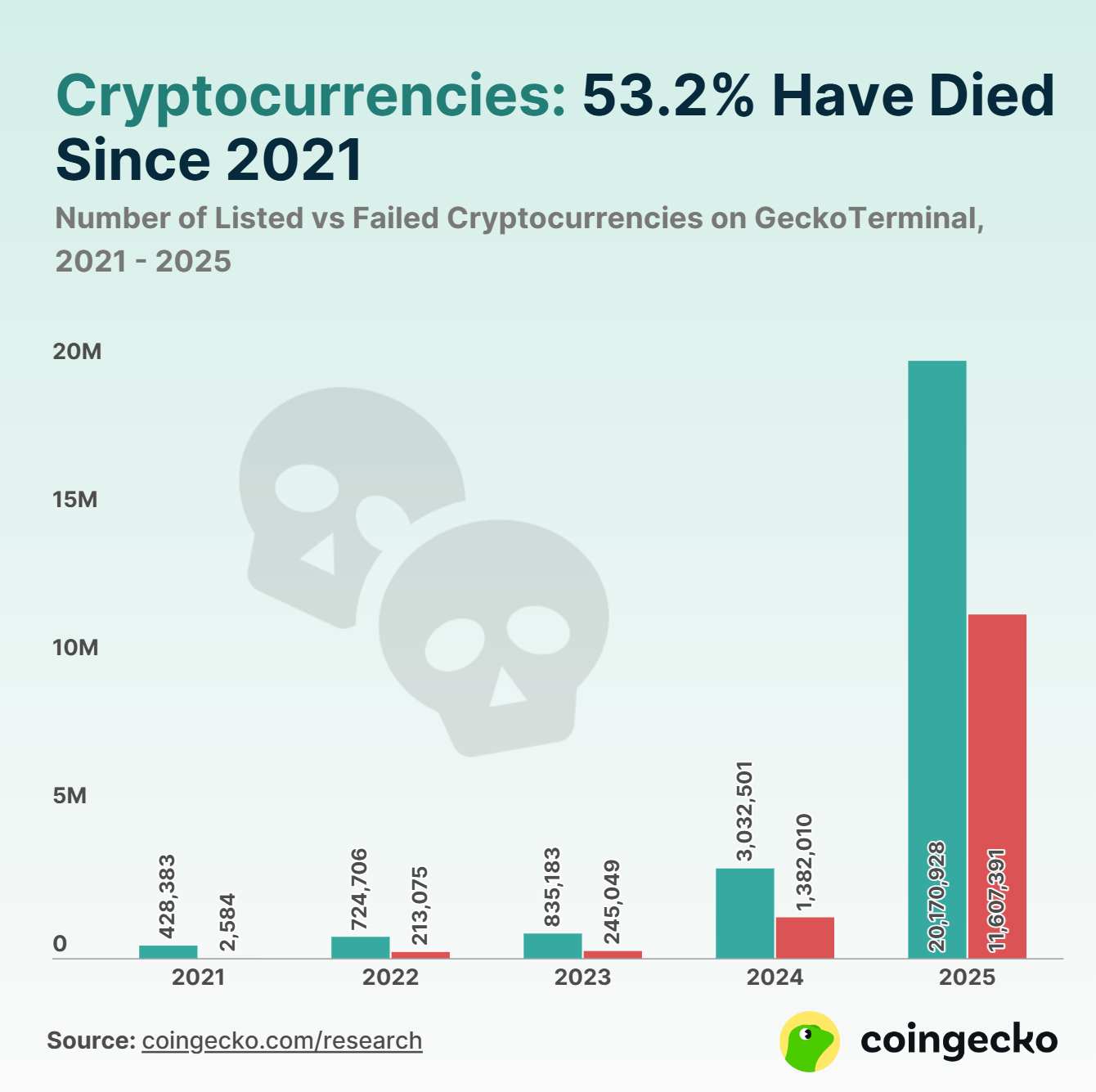
Between mid 2021 and 2026, 53.2% of all crypto currencies listed have ‘died’ - meaning these tokens are not being traded anymore. 86% of these ‘failures’ happened in 2025 alone, showing that without a proper business plan, your Web3 startup is likely to fail.
While abstaining from raising capital privately gives you the most freedom to operate your business as you see fit, it also means the most exposure for you personally. If you don’t make sure you do everything in your power to bring in the revenue you need, your business may bleed money and could eventually fail altogether.
What is the most difficult aspect of growing my business organically?
- In short: The effort it takes to build a successful business. Be prepared to spend many hours and days finding the right product-market-fit, structuring your business model the best way possible, expanding your business and with everything else that may come up on your way to success. You may find success without going above and beyond, but you should be aware of the fact that exactly that might be what’s needed of you to achieve your business goals.
- Keep in mind that you’re one of many Web3 startup founders trying to become successful. Finding the right product market fit and marketing your product and company accordingly is the make or break of your business. Successful entrepreneurs and founders grow and evolve their businesses and revenue, which is the only thing that can keep a business alive and profitable over a long period of time.
Raising capital privately from VCs and other investors
A private fundraise is a common option used by startups in Web3. If successful, this method, in most cases, ensures enough operating capital for a business for multiple years.
It is also a method that can make it easier to get through difficult market conditions, as these often affect startups in Web3 to a large extent. If your company is sufficiently capitalized through a private raise, you might be able to get through a rough patch in the market without much difficulty.
What are the biggest difficulties in raising private capital?
- Finding enough and the right investors. It might take you several months of talking to investors to actually achieve an investment, so be prepared to spend a lot of time finding and speaking with potential investors.
Raising capital through crowdfunding
Crowdfunding is another well-established method for crypto and Web3 startups to raise capital. In essence, it allows your community and other retail investors to participate in your fundraise and thus buy a share of your company, or a certain amount of your tokens at an early and low price.
Crowdfunding is great for marketing effect and to engage your community. The bigger and more engaged community you have grown up in until this point, the more likely you are to successfully raise a significant amount of capital through crowdfunding.
Many startups also use this method in combination with a private raise.
What are the biggest difficulties with crowdfunding?
- Generate enough interest and engagement through marketing and growing your community. Without a significantly large and engaged community, there simply won’t be enough public interest in your public token sale. It’s about perception: the more visible your company and token sale are, the more likely you are to succeed with your token sale.
If you’re looking for more detailed information about fundraising and how to approach investors, read one of our previous articles on how to raise capital in Web3.
Working with the right partners in Web3
Every sector of business is competitive, which is necessary and healthy to incentivize companies to deliver the best possible products and outclass competitors.
But not every kind of competition is healthy. Due to its financial nature, the Web3 economy houses many entities and players that don’t have the best at heart when it comes to your company.
Here’s what you need to know about certain entities you will most likely work with, in order to avoid working with the wrong kinds of partners:
Market makers
Market makers come in all shapes and sizes, but what they all have in common is that, as well as every other business in web3, their goal is to be profitable. Many market makers offer multiple models you can hire them with. Here's what you should know:
- Be careful with loan models
Some market makers will offer to work with you on a loan basis. This basically means that you don’t have any upfront costs, but you’re basically building up debt with them. In most cases, this debt is paid back through the market makers liquidating your tokens on the open market, which, if not done carefully enough, can often lead to token performance suffering to a large extent and thus put your business in a difficult position, both reputationally speaking and financially speaking.
- Ensure you get the transparency you need
Market makers basically handle a multitude of transactions for you, provide liquidity and generally often have a good understanding and overview of your token supply in the open market.
What’s crucial for you is to ensure that you get transparent reporting of the trading activity of your market maker. If you don’t know what’s really happening, you might be taken advantage of.
Influencers and KOLs
Influencer marketing is one of the most-, if not the most viable marketing strategy nowadays. They simply are one of the best ways to reach a large and meaningful audience. It should go without saying that these influencers won’t be promoting your company and business pro bono.
Their capital comes from sponsorships and marketing deals, which in crypto often means a certain amount of token supply allocated to influencers. In all cases of working with influencers, always be aware of and ensure the following:
- Establish reasonable vesting schedules for influencers
- In essence, an influencer is a service provider who provides marketing services to you, for which they will get paid. If you do agree on a deal with an influencer that would pay them a certain amount of your tokens, you need to make sure to vest these tokens over a reasonable timespan. If you give any stakeholder enough tokens that they could liquidate too early, you may put your business in jeopardy before it even really starts growing.
You can use tools like Decubate’s TMS in order to make token distributions to influencers easier, more transparent, and also flexible, in case the influencer(s) you sign contracts with don’t uphold their end of the deal, so you can cancel the distribution to those influencers.
- Only work with influencers who have good reputations
- Before signing any agreements with influencers, do some research. See which influencers talk about topics close to your business and how their communities react to the content they post. Working with the wrong influencers might have a negative impact on your business and token.

Token listing
As a tokenized startup, you will inevitably come to the point where you will list your token on the open market. The two most typical ways to do so are to list your token on either a DEX (Decentralized exchange) or a CEX (Centralized exchange). Centralized exchanges account for more than 75% of all trading volume across Web3 and crypto. However, finding the right platform for your token listing can be difficult as well as expensive. Here’s what you should know.
- Plan according to your business goals and budget
- Listing on a centralized exchange platform will most likely cost you a listing fee. These listing fees may vary depending on the exchange you’re aiming to list on, but be prepared to spend anywhere between $10,000 up to $1,000,000
- While centralized exchanges dominate the market in terms of trading volume and user numbers, a listing doesn’t guarantee success for your token. Avoid spending a large portion of your budget on an exchange listing and rather focus on completing the milestones in your roadmap and organic growth.
- Work only with exchanges or platforms directly
- A large number of Web3 consulting agencies, or sometimes even individuals offer brokerage services for exchange listings. The deals that these providers can arrange for you can often be intransparent and very overpriced. These entities are earning commissions through every exchange listing they can arrange, so they are naturally positioned to aim for the highest possible listing price for your token, to grow their potential commission.
Listing your token on a DEX comes basically for free, but you will need to open a liquidity pool and provide ample liquidity for people to trade against your token, for example: if you were to list your token on a DEX at an initial listing price of $0.10 you would need to deposit 1 token and $0.10 in a stablecoin of your choosing. The more liquidity you add to your liquidity pool, the deeper the liquidity becomes, making most individual trades less impactful on your price, but providing more liquidity also means having to expend a significant amount of capital in order to enable trading. Be aware that any liquidity you add, you risk losing, depending on trading activity in your trading pool.
Avoid middlemen and brokers and work with exchanges directly if you do choose to list on a centralized exchange.
Conclusion and key takeaways
Operating and growing a business in Web3 can be tough. The market and the audience you’re addressing are both somewhat unforgiving, as well as volatile.
Any founder in this space needs to be aware of the overall sentiment within both the Web3 market and the overall economy as well, to be able to see and understand trends and adapt to everchanging market conditions.
Founders of Web3 startups need to be aware of the overall market sentiment, need to ensure their business is sufficiently capitalized and choose the right partners or platforms to work with. Partners need to be selected carefully, considering their reputability and standing, exchanges should be analyzed by fees, liquidity depth and user numbers and the current market sentiment needs to be understood on a fundamental level. Founders who carefully analyze their environment and make their decisions based on researched evidence are ,in many cases, much better suited to grow their Web3 startup into a successful business.


